They Dug Up Your Childhood, Slapped a Logo on It, and Charged You $85 for the Privilege
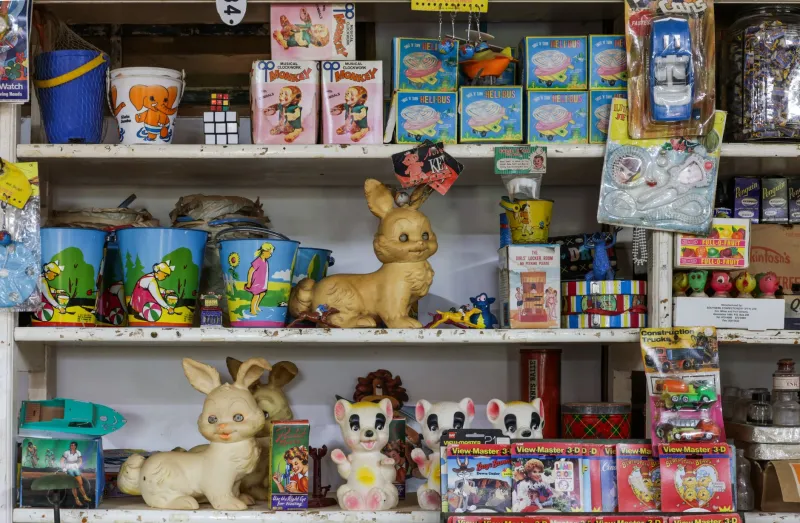
A grown adult paid $120 for a Polly Pocket last year. Not a vintage one. Not a collector's item with documented provenance. A new one, designed to look like the old one, manufactured specifically for people who had the original in 1993 and were apparently not done with it.
This is the nostalgia economy. It is enormous, it is growing, and it has correctly identified that your fondest memories are a direct line to your credit card.
The Memory Heist
Let's be precise about what's actually happening here, because it's more calculated than it looks. Corporations — specifically the ones sitting on intellectual property from the 1980s and 1990s — have discovered that cultural memory operates like a commodity. It can be warehoused. It can be rationed. And it can be re-released in limited quantities at precisely the moment when the people who originally experienced it have disposable income and a complicated relationship with the passage of time.
This is not nostalgia. This is nostalgia management. There's a difference.
Real nostalgia is involuntary — it's the smell of sunscreen that takes you somewhere specific, or a song that hits you sideways on a random Wednesday. Manufactured nostalgia is a product launch strategy. It involves licensing meetings, demographic analysis, and a very deliberate decision about which piece of your childhood to excavate, polish up, and sell back to you at a margin that would make a pharmaceutical company blush.
The Cereal Box as Cultural Artifact
Few sectors have weaponized this more aggressively than the food industry. The limited-edition cereal drop has become its own genre of consumer event, complete with artificial scarcity, countdown timers, and the kind of frantic online purchasing behavior previously reserved for concert tickets and Supreme drops.
Cerealsthat disappeared from shelves in 1997 — often for completely reasonable commercial reasons, like the fact that they were not particularly good cereal — have been resurrected as special releases that sell out in hours and appear on eBay for three times the retail price by the following morning. Adults who ate these cereals as children, who have no particular need for a novelty breakfast product, will absolutely stand in line for them.
The cereal is not the point. The cereal is a vehicle. What's actually being sold is a brief, supervised return to a time when your biggest problem was whether Saturday morning cartoons were good this week. That's worth something to people. The brands know exactly how much.
Board Games for People Who Can Afford Therapy
Somewhere along the line, someone looked at Monopoly — a game that has destroyed more family relationships than most documented disasters — and thought: what if this, but $200 and artisanal?
The luxury board game market is a genuine thing that exists and is growing. Classic games from the collective childhood of Gen X and elder millennials have been redesigned with weighted metal pieces, hand-illustrated cards, embossed packaging, and price points that suggest you are investing in something rather than purchasing a game you will play twice and then put in a closet.
The pitch is sophisticated, in a way that's almost admirable. The original Clue was cheap and plastic and smelled like a toy store. The new Clue — the one with the linen box and the illustrated character cards and the $95 price tag — is an "heirloom edition." You're not buying a board game. You're buying something to pass down. You're buying permanence. You're buying proof that the things you loved as a child were worthy of being taken seriously by adults.
Nobody is going to pass that down to anyone. But the feeling is real while it lasts.
The Artificial Scarcity Machine
The nostalgia economy runs on scarcity, and the scarcity is almost entirely manufactured. There is no logistical reason why a brand cannot produce enough units of a revived product to meet demand. They choose not to. Limited availability isn't a supply chain reality — it's a marketing feature.
Scarcity creates urgency. Urgency creates the fear of missing out. The fear of missing out bypasses the rational part of your brain that knows you do not need a limited-edition G.I. Joe in collector packaging and goes straight to the part of your brain that is eight years old and does not want to be left out of something.
This is why the drops are announced with countdowns. This is why the quantities are always just slightly lower than demand. This is why the secondary market exists and is tolerated — because $200 Furbies on eBay generate free press coverage that money literally cannot buy.
You are not a consumer in this transaction. You are a mechanism.
What the 300% Markup Is Actually Paying For
Here's the question worth sitting with: what exactly are you getting for the premium over the original?
In most cases, the product is functionally identical or marginally better in ways that don't matter. The nostalgia-edition sneaker uses the same sole as the original. The reissued action figure is made from the same materials. The collector's cereal tastes exactly like it did in 1989, which is to say: fine, sugary, aggressively not something an adult should eat for breakfast.
What you're paying the markup for is the feeling. Specifically, the feeling of having retrieved something that was lost. The brands are not selling you a product. They're selling you time travel — or the closest approximation of it that a supply chain can produce.
The tragedy — and PageRatta does love a good tragedy — is that the original version of the feeling was free. You had it. You lived it. It belonged to you in a way that no reissue can replicate, because the original was yours without a price tag attached.
The luxury Polly Pocket is not your childhood. It is a very expensive reminder that your childhood is no longer available, and someone figured out that you'd pay $120 for that reminder anyway.
The machine thanks you for your purchase. It's already working on what to dig up next.